discover
Port Allen
As a small, intimate community within the Baton Rouge Metropolitan Area, Port Allen offers the best of two lifestyles – country living and big city life.
Port Allen takes great pride in its schools, with an emphasis on combining tradition with the latest technology.
Several of our schools have recently undergone significant renovations – and Port Allen Middle School has been placed on the National Register of Historic Places. Constant updating of academic programs also prepare Port Allen’s young people to excel in the 21st century.
An excellent transportation system of highways, bridges, railroads, and navigable waterways enable the City of Port Allen to flourish and attract new businesses. In 2014, Louis Dreyfus Commodities signed a new lease on the city’s grain elevator facility (formerly operated by Cargill). The company has launched a $150 million expansion and modernization program that will also include a new dock for loading of barges. In addition, Genesis Energy is building a new bulk crude oil pipeline through the area – and Drax Biomass has based a new shipping facility in Port Allen to export its wood pellet fuel products worldwide.

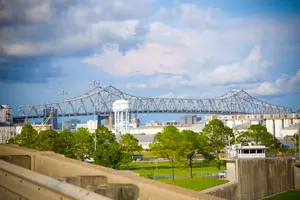
The Port of Greater Baton Rouge serves barges and ocean-going vessels with excellent import and export facilities for all types of cargo. In addition, the port’s status as a Foreign Trade Zone makes it an economic value center of international commerce for the city and parish. The Port Allen Lock provides river barges and other vessel access to the Intracoastal Waterway, shortening the distance to the Gulf of Mexico by approximately 120 miles. In addition, several manufacturing and service distribution centers are located in Port Allen’s industrial park, Westport.
Port Allen is serviced by Interstate 10 and U.S. Highway 190, both of which intersect with LA Highways 1 and 415. The Kansas City Southern, Union Pacific, and Canadian National Railroads also service the area. Terminal facilities within the parish area are also available for motor freight carriers.
Located just eight miles from Port Allen, the Baton Rouge Metropolitan Airport offers services from several commercial airlines. United Parcel Service, Federal Express, and Airborne parcel pick-up and delivery services are also available in downtown Port Allen.
Combining outstanding resources for businesses with a family-friendly community, Port Allen is an ideal place to live and work. We invite you to visit us anytime and explore everything our great city has to offer.
Since 1809
Our History
The roots of Port Allen date back to 1809, when a settlement named La Ville St. Michel was established near the site of the current city.
While that first settlement was lost to the shifting waters of the Mississippi River in 1870, a new settlement was soon established nearby. In 1878, this settlement was renamed Port Allen after Henry Watkins Allen – a Confederate general who was elected as the 17th Governor of Louisiana in 1864.
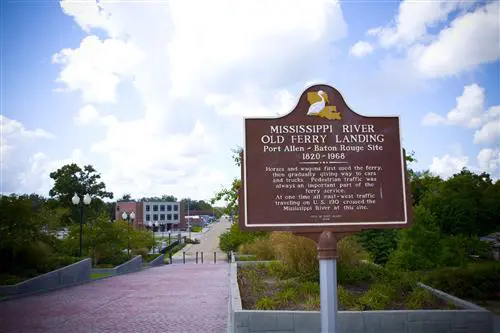
The Village of Port Allen was officially incorporated in 1916 via proclamation of Governor Luther E. Hall – and was later designated as a city in 1923. By that time, Port Allen had already been playing a significant role in the transportation of goods throughout the region. For example, the Baton Rouge, Gross-Tete, and Opelousas Railroad was chartered in 1853 and had a terminal across the Mississippi River from Baton Rouge in the area that would eventually become Port Allen. A ferry would cross the river three times each day at this location to transport goods and train cars.
It was around this junction between the railroad and the ferry that Port Allen grew. The ferry would continue to operate until 1968 – carrying both vehicles and pedestrians – until the Interstate 10 bridge made the service obsolete. However, both the depot and the old ferry landing remain as historical sites within the city of Port Allen to this day.
One of the keys to the continued growth of Port Allen was the construction of the Port of Greater Baton Rouge, which began in 1954. Situated at the convergence of the Mississippi River and the Gulf Intracoastal Waterway, it is now one of the 10 busiest ports in the country. With the construction of the port’s General Cargo Dock No.1, the Grain Elevator, and the Grain Dock, Port Allen soon became a hub of local industry.
With the opening of the port, the City of Port Allen experienced a population boom in the late 1950s – with the number of residents nearly doubling. As local industries continued to grow in the area, the city’s population also steadily increased before finally peaking in the 1990s.
Today the City of Port Allen is known as a small, friendly community that still plays a large role in business and industry in the Baton Rouge area.